Category: family
Busy Breasts–My first published non-fiction!
So overwhelmed right now, I totally missed the publication of my first non-fiction piece: Busy Breasts.
At least I discovered it in time for Breast Cancer Awareness Month.

Check it out there: Busy Breasts by Lana Ayers
Many thanks to the Linden Ave Lit Journal!
Interview with Author Loren Rhoads
I’m excited to host an interview with author Loren Rhoads here today.

Most writers I know were starry-eyed readers as children. What do you recall about the first stories that captivated your heart?

My mom used to read books to my brother and me at bedtime. The first one I remember falling in love with was Peter Pan.
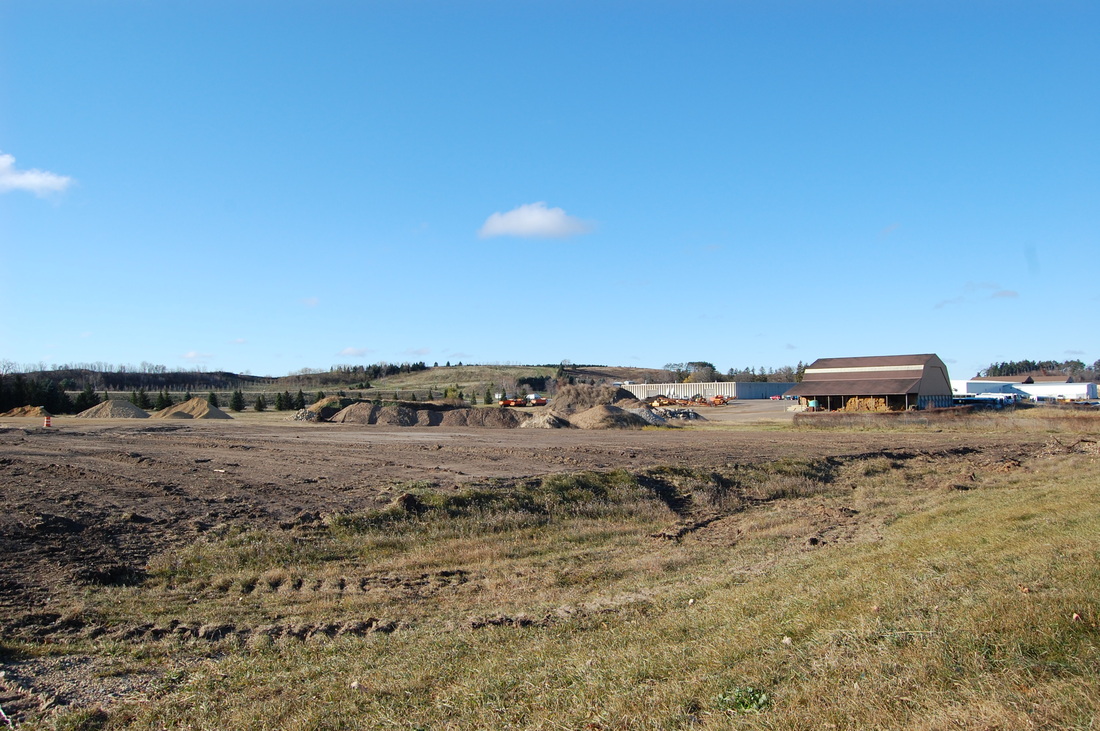
I’m not sure what about the story intrigued me initially, but when I was four, my family moved to a brand-new house built in the middle of one of my grandmother’s fields. There wasn’t any yard, then, just piles of dirt dug out for the basment. All around the house rose these little hillocks, covered in willows and weeds and wildflowers.

Everything seemed feral, like something out of Neverland. My brother and I acted out our own Neverland adventures. We were so disappointed when the steamroller finally came and smoothed everything out for a yard.

When did you start writing your own stories?

I’m not sure when I first started writing things down, but I remember when I started to tell myself stories.
My mom was a firm believer in naps. She was in her 20s, working full-time as an English teacher, with two kids under 5. She may have needed a nap more than we did.

In order to get us to settle down, my mom made my brother and me get in her big bed with her. I had to hold still so they could sleep. I passed the time making up stories. They were about mermaids, like the puppet Marina in the Stingray show on TV.

What made you keep going?

When I was in junior high, I met some girls who actually wrote their stories down so they could pass them around. We didn’t think of ourselves as writers, really. We just wanted to share the stories we had in our heads. Sharing stories was a revelation for me.

I loved that I could create pictures that would live inside someone else’s imagination. I took my first creative writing class in high school. After that, I took every writing class I could find.

What was the path to publication like for you?

It’s been a long road. I published my first stories in the 1980s, after I went to the Clarion Science Fiction and Fantasy Workshop.

Soon after that, I had a teacher who discouraged me from writing science fiction, so I turned to horror. The horror community was so much more welcoming.

Since then, my short stories have ranged from erotic horror to science fiction to urban fantasy, while my novels have been space opera and a succubus/angel love story. I’ve written a couple of nonfiction books about cemeteries, too.

What was the best writing / publishing advice you ever received?

Years ago, I met Ray Bradbury, my writing idol, at a book signing in San Francisco. I told him I was struggling with my first novel because I felt like I had to know everything before I could write a word. I felt like I needed to be an expert.

He told me not to think about it so much. “Just write,” he said. “You’ll find out what you need to know as you’re writing. Don’t think so much.” He was so very right. I’ve been a pantser ever since.

Was there any unhelpful or bad advice you can steer hopeful writers away from?

I hate “Write what you know.” What you know can be boring. Write to find out what you think. Write to discover things you want to know more about. Write what you’re interested in.
What would you like readers to know about your work?

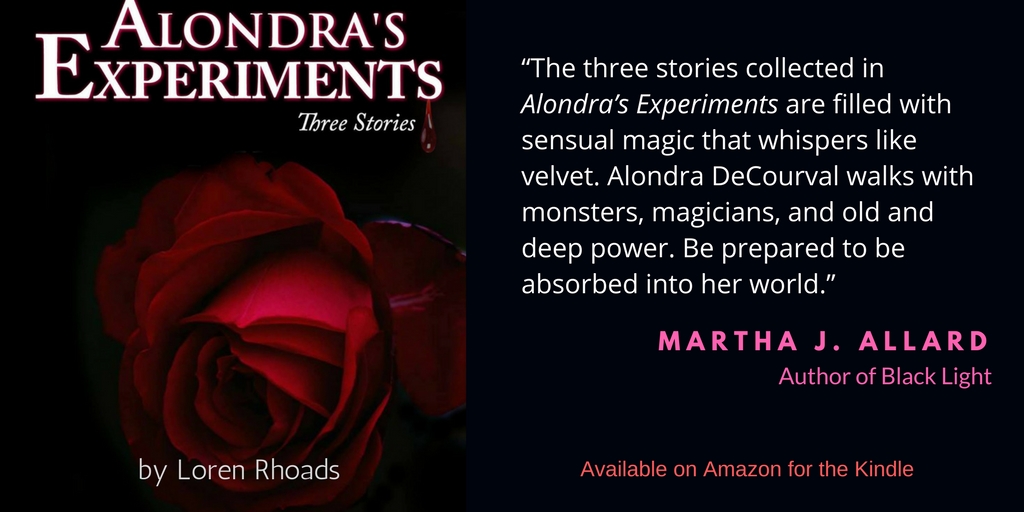
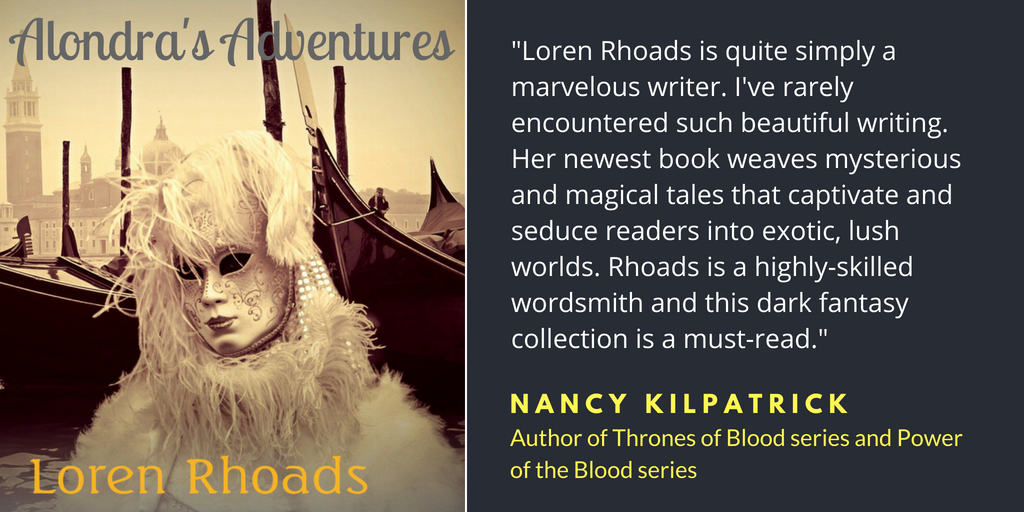
My latest project has been a series of short stories about a witch who travels the world to find monsters. Her stories combine my love of travel with the old “psychic detective” stories. I’ve released three short collections on Amazon and plan an omnibus paperback edition of them for the fall.
Here’s the link to the first collection: Alondra’s Experiments
What question do you wish I would have asked that I didn’t?

What am I working on now? I’m glad you asked!
I’m editing a charity anthology for my local Horror Writers Association group. The book is called Tales for the Camp Fire. We’ll be selling them to raise money for survivors of last year’s devastating wildfire, the most devastating natural disaster in modern California history. The book should be out in May. I am really excited about the caliber of the work in it.

To learn more about Loren Rhoads online,check out her site: lorenrhoads.com/

Thanks for stopping by! Happy writing & reading all.
Meltdown by Sally McGee
I am fortunate and grateful to share with my readers this exquisite essay by writer Sally McGee that speaks to all of us #metoo survivors with such grace and courage.

Sally McGee is a writer, community organizer, and nature conservancy advocate living on the Oregon coast. In the 1970s in New York, she worked tirelessly until rape survivors were treated by legal authorities with the dignity and respect they deserved as victims of a serious crime, instead of the blaming-the-woman mentality that prevailed for decades.
MELTDOWN by Sally McGee
The phone rings.
A neighbor was calling looking for a reference.

Some people I know want to rent his house.
Unable to get a letter of recommendation and having heard some unsavory things, he was looking for information.

Could I tell him anything?
I begin to shake and find it hard to get words out.
The man is big and menacing.

Often unemployed, he has drinking and anger management problems.
The police have been called.
What can I say?

I find it hard to talk and begin to stutter.
I am surprised at how shaken I am.
Things get worse as the week progresses.

The night descends and I crawl into bed.
The nightmares begin.

Growing up female in an out of control family, I was often afraid.
I wake feeling disjointed.
Something is trying to rise from my unconsciousness.

What my body knows, my brain has not yet figured out.
I am confused.
Monday I think is Friday. Wednesday is Monday.

Get it together! You are scaring people around you.
It is the trauma that is being brought forth from early childhood.

The trauma triggered by 11 white Republican men wanting to grill a sexual assault victim while her attacker looks on.

A woman who thought she was going to be murdered, the weight of a male body pinning her down.
His hand on her mouth stifling her screams while his friend looks on.

Some on the committee have already pronounced her guilty.
Senator Orin Hatch, well established member of the Republican power structure, next in line after the Speaker if something untoward happens to the President and the V.P., has pronounced her, “Confused”.

Virtually the same thing he said 20 plus years ago during the testimony of Anita Hill before the Judiciary Committee during the Clarence Thomas hearings and we know what the men did then.

If they win this one, it will be a Pyrrhic victory.
Too many women are watching and feeling the attack on Professor Ford to be an attack on them.
Old traumas are being re-lived.

Traumas that will spell the death of the Patriarchy.
And I say, “Thank God”.

Some years ago I spent 8 days in the Trinity National Forest in Northern California backpacking; 3 women, 3 dogs.
Leaving, the hardest part was saying good by to the trees.
There was no wrapping my arms around the trunk because of their mammoth size.

But I leaned into them and quietly spoke of my love.
The surprising thing was the response.
Clearly they said, “We love you.”

This forest burned in the fires of 2018 but destroying the Redwoods is next to impossible.
They were here in the beginning.
One of the oldest life forms.
Their presence is a gift that uplifts me and sustains my life.
And for them I am grateful.

With trauma in the news every day, I vow I will not be defeated.
All is not lost.
Life goes on.

I live in a community that was logged 100 years ago.
The trees were cut down and removed but their life not destroyed.
Many came back and today I walk among them some 60, 70 feet tall.
They are unusual looking because the cut made 100 years ago was 10 or more feet above the ground so the tree I see today has very large roots high above the ground.

I make my escape running to Sanctuary, the family home in Portland where my daughter and her B.F. live.
The house was built in 1915 and is in one of the older, close-in neighborhoods.
Craftsman houses and Bungalows surrounded by very large trees that were somehow spared 100 years ago.

Sanctuary and I am safe.
Surrounded by family and loving neighbors.
Children’s voices ring out.
It is music to my ears.

I rest and sleep.

Thank you, Sally McGee for your lovely words.
For a survivor like me in this treacherous time in our nation, your words are my balm and sanctuary.

Poet Christopher J. Jarmick: Thoughts on Writing and Dealing with Inner Darkness
What do you call someone who opens an independent brick & mortar bookstore in this age of e-everything?

A fool?

An optimist?

A bit of both?

NOPE. Not at all.
I call him a super hero!

Christopher J. Jarmick is not only a marvelous poet, but a owner of the wonderful BookTree in Kirkland, Washington.
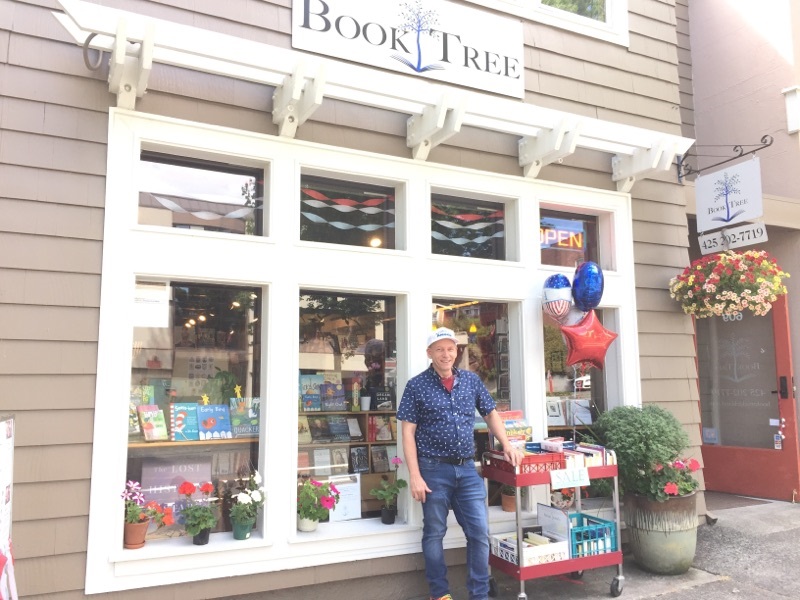
Click this Link to go to BookTree website
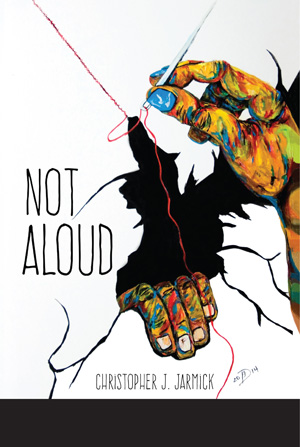
And I had the good fortune to publish his incredibly passionate collection Not Aloud with MoonPath Press.
A little more about Chris:
Christopher J. Jarmick is owner of BookTree, Kirkland’s independent book store. Creative and Freelance Writer, he’s author of Not Aloud (2015 MoonPath Press).
Visit him on his blog, PoetryIsEverything
Click this Link to Chris’ Poetry is Everything blog

Before I get to the interview with Chris, I can’t help but post a favorite poem from Not Aloud.

First question, Chris–
What brought you to poetry?
It happened in stages. First Garden of Verses by Robert Louis Stevenson and Dr. Seuss. Rhymes were fun.

Then I discovered Coney Island of the Mind by Lawrence Ferlinghetti when I was about 11. I thought this is amazing.
This is poetry?

Who is this guy?
And getting answers meant going to the library back in those pre-internet/Google days and asking questions.

I learned about the ‘beats’ and this amazing poem called “Howl”:

I tried to understand more about these poems and poets and I became interested in their influences Blake, Baudelaire, Rexroth,Whitman (plus many many others and noticed some anti-war poetry from Denise Levertov and others).

I started writing poetry and got a poem published in a national magazine when I was 12 (Dear Troubled Youth).
I must be a writer and poet, right?
And so I was bit.

I realized how poorly poetry was taught in schools (most of the time) and I would have soured to it if I had not made my discoveries and done research on my own.

What is the best advice you received as a writer?
Read.
Read everything and remain curious.
Read, observe, and listen.

You want to be open and truthful and develop your b.s. detector.
If you don’t like reading very much, you aren’t going to be a writer worth reading.

‘Write every day’ is also very good advice.
Too many resist this one.

Write fast and edit later.
If you can’t just write, get a prompt and write to the prompt and challenge yourself.

You learn more by failing than by being successful.
So fail often (hopefully in private).
It is important to also accept that it is okay to skip a day or two of writing.
Forgive yourself. But no excuses. No laziness.

Develop the habit, the writing addiction.
Get over yourself and write even if it is junk.
You absolutely must read every day however.
Read more, write often and accept that most of what you write will be awful.

What is the least helpful advice you received?
“Write what you know.”
Terrible.
It should be:
Write and when you discover you don’t know what you are writing about—research, learn and then write some more.
You don’t know, what you don’t know and you are always learning so why would you stick to writing what you know?

Writing is always a journey and journeys are supposed to be meaningful and that means you are learning as you journey; sharing and teaching as you write.
As you experience life of course write about that, but let it lead you to new paths and new discoveries.

“Find your voice” is another bit of supposedly helpful advice that is also problematic.
You already have a voice and while you absolutely need to explore and discover as much about yourself and therefore develop your voice, it is already a part of you.
It’s the voice that is insisting you write.
You can write in different voices, you can be a mimic, you can stretch and should stretch until you are uncomfortable and then stretch some more.
The true voice that you already have will tell you what is b.s. and what is honest if you remember to listen.

If you read and listen more than you write you’ll have an authentic voice– nothing to ‘find’, it’s already within.

Most creative people go through difficult or dark times.
What helps bring you back up when you are down?
Sheesh.
If you get to your 30s or beyond and are a sensitive creative sort of spirit, then you have developed some coping mechanisms that are working.
Managing frustration, foul moods, self-doubts and other things would be a full-time job if I didn’t develop a way to take a quick time-out.
Get the hell out of my own head.
Stop blaming others. Fathers, mothers, husbands, wives, abusers… the blame game won’t let you heal.

Deep breathing exercises a couple of times per day (5 minutes is often enough time) and some positive self-talk that isn’t too sweet or insipid is necessary.
All you have control over is how you will deal with the day.

Let good things happen.
Let the good in.
There is also good around you that is yours for the asking.
So ask and take some of the good.

When darkness closes in I wonder if there is someone I have not forgiven that I am allowing to take control of my mood.
You must forgive and stop carrying more weight around than you need to.

There will be times when you might have to fake it for the benefit of someone near you that doesn’t need your dark mood.

The most difficult person to forgive is yourself but you must learn how to be better at that every day.

There are some people that I used to spend time with who were very negative and overly critical.
I can be negative and overly-self-critical without anyone’s help so obviously I learned that life is too short to spend too much time with very negative, ‘mean’ people.
Most of these people weren’t close friends so it’s common sense to limit my time with them.
I don’t have to avoid them, its simply a matter of not spending too much time with them.

One can also escape with a movie, or a book or by eating a little too much ice cream or playing music waaaay too loud.

I learned by my mid 20s that killing yourself slowly through drugs or alcohol is just another way of wasting time and being irresponsible.
It creates more problems and more darkness.
And too much escape will only create a super storm that will knock you on your ass.

Sometimes I recognize a dark cloud coming in and I can minimize its visit.
I sometimes can be affected and even infected by my perception of someone else’s mood.
It may not even be completely real and I take it upon myself. Foolish.
I tell myself it might make me a better writer but it doesn’t help my balance.

Having a variety of ways to deal with the challenges is important.
Sometimes my methods are successful. Sometimes it is being in the writing zone, writing away for hours at a time that keeps me somewhat sane.

What do you want others to know about your poetry?
It is an exploration, a journey, a specific observation.

It doesn’t take itself too seriously and the poem itself is not sacred—behind the scenes the act of writing the poem is sacred (often)—but you do not need to ever give a damn about that.

My poem is alive.
My poems (most of them) are cats, dogs, chickens, or insects.

I would like the poem to allow you to consider or ponder or explore something differently.
Many poems have done this for me and so I want my poems to do it for others.
I would love if my poem assists you and what I think I mean by that is
a) it connects to you perhaps giving you a little more confidence or helps someone to feel a little less alone, a little less crazy
b) it inspires you
c) it makes you smile
d) it resonates because of how it states something or because of a meaning you see in the words
e) it makes you uneasy, it bothers you or makes you a little angry
f) bottom line: it compels you to react and do something (maybe even write).

Some of the poems I write are fun, even show off a little, some are satiric, sarcastic and hopefully done with wit and respect for language.
I hope a poem or two of mine will make the reader (or listener) think, okay that’s a little different AND it’s poetic.

A writer reads.
A writer writes.
A poet as the word origin dictates: creates.
(Poesis~Greek word for creation is root of poetry).

Here’s another poem by Christopher J. Jarmick:
LEARNING FROM LEONARD COHEN
You learn
about best defenses;
keep tears back
with a smile;
never leave the heart out
upon your sleeve.
Some do get older
with vulnerable hearts.
The sparkle
in an eye proves
a passionate intense life.
It is a blessing,
a curse.
It is brave, very
foolish, human.
If you have met
a few who understand,
you are rich.
If your heart has been broken
more than twice
and still gives
you are living your life
very well indeed.

Click this link to buy NOT ALOUD from IndieBound
Click this link to buy NOT ALOUD from Amazon
Thanks to everyone for joining Chris and I here.
Wishing everyone brighter days filled with poetry and joy.

Poet Patricia Fargnoli Talks Writing, Love of Words, Advice
Patricia Fargnoli is simply one of the finest poets writing today.
And Pat’s an important person in my life.
I’m honored to host her on my blog.

Patricia Fargnoli, a former New Hampshire Poet Laureate, has published five award-winning books and three chapbooks.
Awards include: The May Swenson Book Award, The NH Literary Book Award, The Sheila Mooton Book Award, Foreword Magazine Silver Poetry Book Award, a runner up for the Jacar Press Prize, and a residency at Macdowell.


She has published over 300 poems in such journals as Ploughshares, Prairie Schooner, Harvard Review et. al.
Pat is a retired social worker and psychotherapist, a mother, grandmother and great-grandmother.
She lives with her cat, Rusty-Griffin in Walpole, NH.

I had the good fortune to become a student in the poetry classes she taught in New Hampshire.

Pat was not only a marvelous teacher, but she took an interest in my work, and became my mentor and supporter and cheerleader.

And ultimately, Pat became my dear friend.
I will never be able to truly express the depth of my gratitude.
Pat’s belief in me is a part and parcel of every success I’ve had with publishing my work.

Without further ado, Patricia Fargnoli:
Thank you to Lana Ayers for featuring my book, Hallowed: New & Selected Poems on her blog.
This month is the one-year anniversary of its publication.

Health issues and issues of aging (I am 80) have prevented me from doing readings or publicizing the book the way I would have wanted to.
So I am so grateful to Lana for her interest in this feature.
How did you come to poetry?
Poetry became an important part of my life very early, largely because of the wonderful Aunt Nell who took care of me after my parents died.
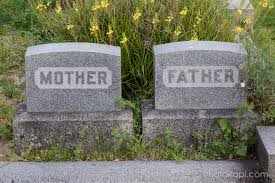
She had been a kindergarten teacher for 40 years and loved children.
Each night, before bed, she would read to me: all the children’s classics, and books of poetry –“Silver Pennies,” “Peter Patter’s Owl,” “The 100 Greatest American Poems.”

Thus, the rhythms and images of poems became part of me…as did the love of poetry.
I wrote my first poem at age seven on Mother’s Day.
It was for my mother and I asked Aunt Nell to somehow send it to her.

Then, in high school, I wrote (very bad) poems for the school newspaper.

I don’t remember writing during most of the years of my marriage and motherhood, but I never lost interest in poetry.
It wasn’t until my mid-thirties that I began to write seriously.
I somehow fell into a graduate poetry class with Brendan Galvin at Central Connecticut College and took it several times.
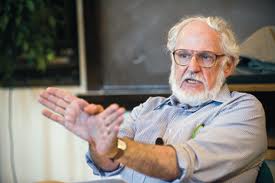
Brendan, who is a remarkable poet, and not easy to please, taught me to write well. I was determined to become a good poet and worked hard.
There were seven other women in that class; we all became friends and, after we stopped taking the class, we continued to meet and critique each other’s work.

Still, the group is meeting, 35 years later.
For financial reasons, I’ve never been able to get an MFA (though I wanted to).
I did, however, attend The Frost Place Poetry Conference and the Bennington Summer conference both of which brought me into contact with well-known poets and expanded my poetry knowledge and world.

Most importantly, I studied at Bennington with Mary Oliver who recognized the value of my work
and became a mentor and supporter of me.

Her belief in me has been a lifelong motivator for me
and I am enormously grateful to her.
My first book was published when I was sixty-two.

[I can’t help but interject here folks — First book at age 62!
Winner of the May Swenson Award!
This fact uplifts me greatly coming so late to fiction.
There’s still hope for me & for all of us late bloomers.]

What is the process like creating a new & selected works? Has your relationship to the earlier poems shifted? Have you discovered anything new in the process?
This is the one year anniversary of the publication of Hallowed: New & Selected Poems
so it is a good time to reflect on the process of creating it.
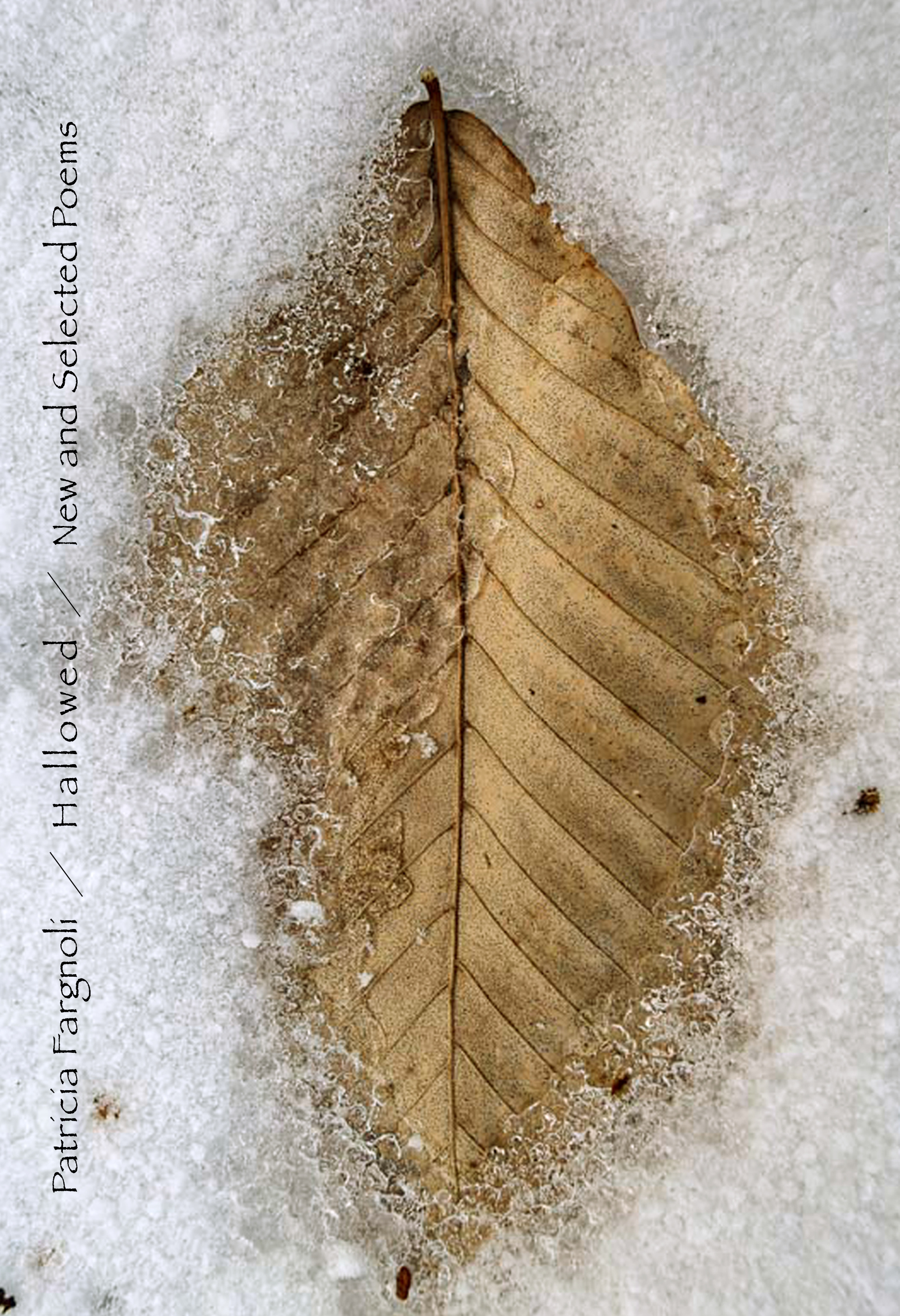
I knew that I wanted to have a volume that recognized my previous books while it also included the new work I’ve written since Winter was published.
And I wanted to do it by my 80th birthday so as to recognize that scary (to me) landmark.

I contacted my previous publishers for permission to use poems from those books and Jeffrey Levine at Tupelo Press said that they wanted to publish it since they had published two of my previous books and considered me to be part of “The Tupelo Family.”

The process of putting the manuscript together was quite easy: I simply chose the best of the new poems I’d written…24 of them, and then arranged them as I would arrange the poems in any book… paying attention especially to the first and last poems but also to the arc of the them and how they connected to each other.

Choosing the poems from previous books was even easier. I knew that I wanted a representative sample from each book, but didn’t want a lot of poems from each book…so I went through each front to back, choosing poems that seemed to encompass the themes of that book and that had gotten recognition through audience appreciation and/or publication…plus those that were personal favorites.

A friend pointed out that I left many strong poems behind and I guess I did but I didn’t want the book to become too long.

What I learned was that some of my themes are lifelong themes: especially grief and loss, how to find meaning and beauty in nature and life, those consolations.

I also recognized that the poems of the first book, Necessary Light, tend to be more narrative than those of later books which tend first toward my lyrical and later to more and more meditative as I aged and began to be more concerned with issues of aging and with the search for spirituality and meaning in a world where there are no (for me at least) certain answers.
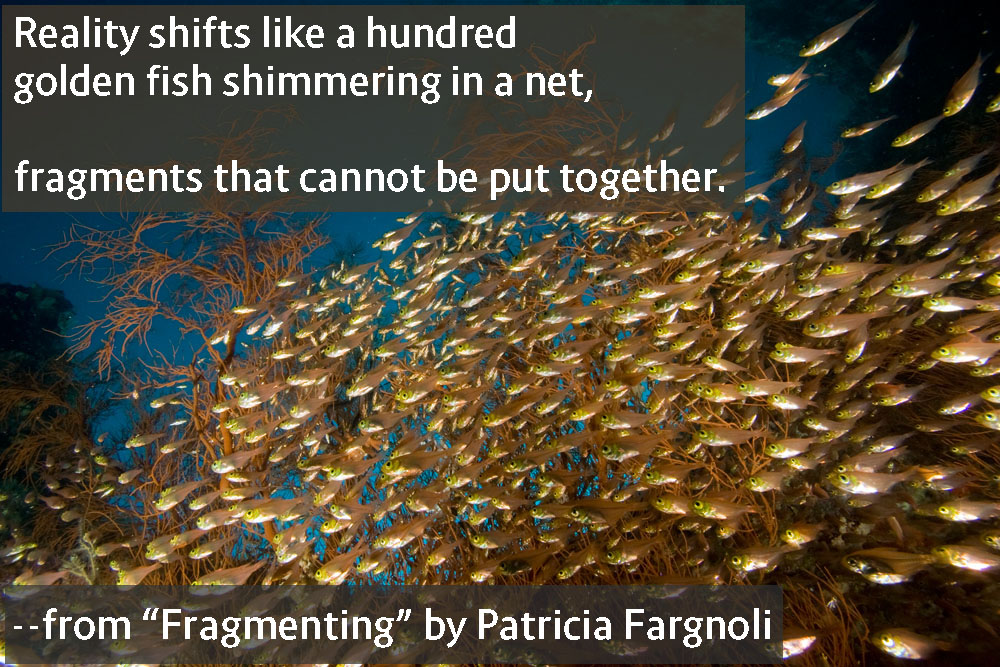
Amazingly, when I had finished the choosing and arranging, the poems from all the books seem to become a cohesive book….something that both surprised and delighted me.

Could you share a poem from the new collection?
To an Old Woman Standing in October Light
Better to just admit it, time has gotten away from you, and yet
here you are again, out in your yard at sunset, a golden light draping itself
across the white houses and mowed lawns,
the house-tall maple, green and rust in ordinary light,
has become a leaf-embossed, gold globe, the brook runs molten,
the clouds themselves glow gold as the heaven you used to imagine.
Do you know that your own figure, as Midas-touched as a Klimt painting,
has become part of that landscape falling around you,
almost indistinguishable from the whole of it–
as if eternity itself were being absorbed into your mortal body?
Or is it that your body, out of time, is merged into eternity?
You have been looking for a reason for your continued existence,
with faith so shaky it vibrates like a plucked wire.
Such moments of glory must be enough. As you search them out again, again,
your disappearing holds off for awhile. But see how, even in this present,
as you stand there, the past flies into the future seamlessly,
the way, above you, the crows are winging home again, calling to each other,
vanishing above the trees into the night-gathering sky.

[Buy Patricia Fargnoli’s book by clicking this link!]
How did this poem come about?
This is the first poem of the book.
The “you” in the poem is, myself as I stand at the precipice of old old age, but also it reaches out to the reader who may be also dealing with issues of aging and meaning.
I wanted to write a poem that used beautiful language and light and spirituality.

I don’t remember much of how I wrote it but I think I must have been in that poem-space where images and words come almost unbidden.

What advice were you given that was the most helpful when you were first showing your poems to others (in classes or workshops or critique groups?
It’s been 45 years since I first began showing others my poems and my memory is not that long.
I think the most important advice I could have been given is to be quiet and listen without getting defensive but, at the same time; to consider carefully all that is said.

Always remember that the poet is the final authority (and decider) about their own work.

Any really bad advice that didn’t help at all, and if so, how did you overcome it?
As for bad advice: negative critiques especially when given forcefully by someone who is sure their opinion is “right” have only left me upset afterwards.
These are not supportive and can be very difficult to shake these off.
I have left critiquing workshops where this happens frequently.

Fortunately, I have been a member for many years of a very supportive and helpful in-person workshop and also an online one where I trust the feedback I receive.

What advice do you have for poets who are struggling in some way–either with getting poems written or with getting published?
I know this is said often but it is so true: read, read, read…all the poetry (both American and International) you can get your hands on.

And study the poems that you are most drawn to, not just as a reader, but as a student learning from their techniques and moves, their language and strategies.

Also read fiction and non-fictions, read magazines, let all that you read become food for your own imagination.

Make writing a priority in your life, make time on a regular basis to do it even if you think you have nothing to say.

Study the journals before you send work to them in order to decide where you own work might fit.

Build a poetry community.
Some poets are loners, I, myself, am an introvert, but I have found that it’s important for me to have a tribe of poets, people I can turn to to talk about poetry, share successes, even moan about failures.

Thank you, Pat for bringing your beautiful, wise, and enlightening words to my blog.
Thank you readers for coming along.
Please check out more on Patricia Fargnoli here: [Patricia’s website]

The Best Laid Plans…
My sweet husband decided that the publication of my very first novel deserved to be celebrated.
In grand style!

So my husband rented a small function room at our local golf course.
And we invited our neighbors and friends here in Tillamook to come share a delicious salmon dinner.

My hubby even had this nearly life-sized blow up of my book cover made up to decorate the room for the celebration.

It was going to be a wonderful celebration.
And for once, I wasn’t even nervous about having to be the center of attention–like I always am when I have to stand up in front of a room full of people.

When my first poetry collection came out, I seriously considered hiring a stunt double to give the readings for me.

(okay, I don’l look like Bowie or Tilda, but you get the idea)
But this time, I was genuinely excited and wanted to celebrate, even if I was going to read a snippet from the book.

I picked out a polka dot dress to wear because it seemed fun for the occasion without being too formal.
And a purple lace bolero to wear over it.


But you read the title of this post, so you know something went awry.
The party went off without a hitch. People had a lovely time. So what went wrong?

Well, only the fact that I couldn’t attend my own party!
Nope.
My body decided to betray me in the wee hours of the morning the day of my party
with excruciating pain.
I ended up in the hospital.

I’m doing better now, after a couple of days in the hospital getting test after test after test.
Diagnosed with an intestinal blockage, I’m recovering slowly.
I may need exploratory surgery if things don’t completely resolve on their own. Hope not.

But for now, I’m okay.
Except I’m completely, totally, thoroughly bummed
that I missed my own book celebration party.

My first thought was I didn’t deserve a celebration, anyway.
My second thought, too.

That’s my mother’s voice in my head talking. It’s nearly impossible to shut her up.
My next thought was The universe hates me.

The universe isn’t out to get me. That’s just silly.
I am just an insignificant speck in the scheme of things.

The Universe doesn’t care a whit about me.
So, here I am feeling pretty sorry for myself.

How lame is that?
What I should really be feeling is grateful.

Grateful to have people in my life who wanted to celebrate with me.
Grateful to be alive.
At all.

And I am.
I am grateful to be here, for however much more time I am granted.

Guess, I am just going to have to do something else worth celebrating.
Maybe write another book?
Or another half-dozen books?

I better get started, huh?
Wish me luck!

Friendship Across the Ether
Over a decade ago through the magic of the internet and the wonder of email, I “met” a poet who lived far away in the southwest named Lisha Adela Garcia. We never met in person, though.

Lisha was putting together her very first full-length poetry collection and thought I might be of assistance. I’ve worked as a poetry manuscript organizer and editor for many years, and I was delighted to take a look at her poems.

The poems were amazing of course! And they turned into her wonderful, acclaimed collection, Blood Rivers, published in 2009.

Through the magic of web ether, Lisha and I have stayed in touch.
But despite never meeting in person, I always felt we had a deep connection.
The connection of our mutual love of poetry, certainly.

But it felt like so much more, too.

A soul connection, if you will. Maybe you’ve felt that too?
As if our life experiences sent us along similar paths.
I’ve always wanted to meet Lisha, hear her voice in person, look into her eyes.
And last week, I finally got the chance as she passed through my town on the way to a reading for her newly published book, A Rope of Luna.

This book is filled with poems of rich culture, family, and spirituality.
Here’s one of my many favorite poems in Lisha’s new collection:

We only had a couple of hours together, and shared a delicious meal. I felt the soul connection even more powerfully in her presence.

And now, we have vowed to get together again.
So, though some may think the ether an unlikely place to form friendships,
with a little bit of poetry,

these ethereal friendships can be deep and meaningful and lasting.
For that, I am very grateful.

Lisha Adela Garcia’s books on Amazon.
A Guest Post from Stacy W. Dixon!
Hello lovely blog readers, I’m being visited by the wonderful poet Stacy W. Dixon this week.
Stacy W. Dixon’s work has appeared in The Mid-America Poetry Review, Tiger’s Eye, Pirene’s Fountain, Sweet Tree Review, Word Fountain, and has been nominated for a Pushcart Prize.

She’s writing about her new poetry collection, Visiting Ghosts and Ground. buy on Amazon

Stacy wowed me with her clear-eyed and powerful poems of grief.
Take it away, Stacy:
“I think we naturally write about how we experience life. My work is often intimate and personal, though not always autobiographical. I am inspired by many things; art, nature, memories, dreams, and family.

The poems in Visiting Ghosts and Ground begin in adulthood and then turn back to childhood memories. My mother and grandmother, and the effects of their loss upon my life, inspired some of these poems. A few of them are influenced by my ancestors, such as Kindred Incantations, Shelf Life, and From a Stolen Child.

I feel this collection is largely about connections to the land and the ghosts of the past. It’s a journey of love and loss, and the desire to keep that love alive.

My hope is always that my work will resonate with others, as so many poets and writers have touched and inspired my own life.”

Thank you, Stacy, for your poems and your post. As in your lovely lines, “Long days/on end/in the bluish hue,” your collection will resonate with anyone who carries loss in their heart.
Visit some of Stacy’s inspiring work online here:
& here:
& here:
As always, thanks for stopping by.

Poem
We Are the Germans (part II)
America 2018
The SS man.
The ICE man and Border guard.
What is ordered,
however immoral, is performed.
The German people,
with proper blood keep quiet.
The American people,
the privileged ones stay quiet.
Not one uniformed person says,
No, I will not do this. This is wrong.
Orders are carried out.
Leaders are pleased.
Jews die.
Children cry.
Injustice is a disgrace
with distinctly human face.
A distinctly American face.
Look in the mirror.
