This month’s Prompt Me poem is a little different. It came out of a workshop with Dana Cunningham Anderson and is dedicated to my dog of 11 years who passed away this month. I’ll be thanking Dana with a copy of my new poetry collection coming out early next year.
For Rainy Day, My Greyhound May 4, 2008—October 14, 2021
Is it a trick of shadow or memory’s insistence that I spy you out of the corner of my eye?
Sleek as a deer, majestic as a lion. The color of shadow yourself, except for your smile, bright as looking into the sun too long, an afterimage burned onto my heart. Tip of your tongue hanging out like a little pink heart itself.
You’re shaking off sleep, perhaps a dream of running, to prance toward your water fountain and quench what must be death’s eternal thirst.
You can’t be here, of course, but even after my eyes adjust to your absence, the jingle of unseeable collar tags, rings and rings and rings like a bell calling me to morning prayers.
Can’t believe after umpteen rejections I finally made it into one of dream journals! Thank you, Tim Green. My poem “Twenty Twenty” published on New Year’s Eve 2020:
My dad died nearly 30 years ago, but if he were still here, he’d turn 96 this week. Happy birthday in heaven, Dad.
Saturday Breakfasts
by Lana Ayers
My dad woke before the
5:30 AM alarm weekdays to ready himself for his hourlong commute to work as a
maintenance man. Weekends too, he rose that early out of habit. On Saturdays he
would trim the yew bush shrubberies, weed the garden, prune the leggy roses,
sweep the driveway and the path leading to the house, all before starting the
loud brassy gas lawnmower at 9:00 AM. The delay in mowing not so much to avoid
waking the rest of us lazy lay-ins—my mother, my older brother, and me—but to
remind us a Saturday is not to be wasted.
Upon hearing the grinding
roar, my brother and I would throw off our covers and rush into the living
room. Being six years older than me, it was understood my brother got to choose
what we watched on TV. Dial on and channel clicked, monsters from outer space
would fill the monochromatic screen. Though I would have preferred Bugs Bunny
cartoons, I learned to love those science fiction B movies as much as my
brother did.
After a half hour of
mowing the small front lawn and driveway median strip of grass outside our 1955
brick ranch house, my dad would come in by the side door of the house that
looked into the living room and peak at us. My brother and I sat cross-legged
on the orange shag carpet, slurping sugary cereal from bright plastic bowls. Dad
would shrug out of his grass- clipping-covered shoes which brought such a rich
smell of life into the dark, dusty house. Then he’d step over to us in his
socked feet to pat us each on the head. Often, there was a kiss instead of a
pat. Sometimes both.
“That’s not a real
breakfast,” Dad would say.
Sometimes I broke away from watching swamp monsters or crazed robots and followed my dad into small square kitchen made darker by brown cabinets in a single East facing window. Dad would begin his Saturday morning routine of removing all the ingredients for a cheese and egg scramble from the refrigerator—the only appliance that seemed to be changed out over the years: first a short stocky Norge that looked more like a bank safe, then an avocado green number, and finally the brown fridge with a darker frame of black—and set them on three-foot length of counter between the stove top and sink.
Next, he got out a mixing bowl from one cupboard, a frying pan from another, and finally a butter knife, spatula and whisk from the drawer below the mustard-yellow corded wall phone. My dad would whistle as he cracked eggs and stirred, not tunes I recognized, but always cheerful. He switched on the gas flame under the frying pan, which came on with a puff, like a teeny explosion. He flipped half a stick of butter off the knife and swirled the pan around, before pouring in the egg, milk, and American cheese mixture.
Dad whistled and stirred with the spatula for a few moments. When he stopped stirring, he went and removed four slices of bread from the wooden bread box on the counter next to the fridge, set those in the toaster beside it and pushed the plunger down. By this time, he’d call out “Plates” loudly if I were still in front of the TV; softly if I were there with him in the kitchen watching his nimble movements .
I would reach into the cabinet under the window and get out a stack of three dinner-sized plates, setting them on the counter next to the stove. My dad gathered clean forks from the green dish drainer next to the sink and handed them to me. A round Formica-topped table was shoved into the corner of the kitchen. Along with forks, I set out a napkin for each of us from the vertical orange holder. Then, I got two glasses out of the dish drain and filled them with milk from the half-gallon carton in the fridge. Then I set butter dish in the center of the table. Dad reached for the percolator next to the toaster and poured a cup of coffee into his favorite mug–a translucent white glass Pyrex cup he’d gotten for free for filling his tank with gas at the Esso station.
“Hot and hearty, come and get it,” my dad would call to my brother.
Finally, when my brother and I were seated, my dad doled out the meal and presented the two of us each with a steaming plate of eggs and a slice of toast. Dad’s only reward to himself for cooking us breakfast was an extra piece of toast to go with his eggs.
Mother never woke early
enough to be treated to the scramble feast. I always wondered if she somehow
resented Dad usurping her kitchen. But my brother and I were delighted to
partake in his generosity—a warm breakfast one day a week. Saturday breakfast
was a meal that perfumed the house with eggy, cheesy, buttery aroma. I probably
could have filled my belly up on the scent alone.
And my brother and I never minded missing a few minutes of the movies, reruns we’d seen dozens of times anyway. Dad never talked while we ate, busy buttering toast and chomping away, though he sometimes hummed between bites of cheesy, buttery eggs. The comfortable silence on these Saturday mornings of warm, satisfying breakfasts was one of the deepest expressions of love I experienced growing up.
I worry over the squeaking sounds the come from the walls between the kitchen and the laundry room. At nights, our cat Silvia, the former feral one from the hoarder house with fifty-nine cats, stations herself in front of the dishwasher, feet tucked under so that she resembles a roast. And one morning we wake to find a quarter-sized daub of blood on the linoleum. Nearby rests something resembling a four-inch long leather shoelace. My husband tells me it’s a mouse tail and I feel faint. We can’t locate the rest of the mouse and hope it made a quick snack for Silvia.
I consider myself lucky that I’ve never experienced rodents inside my home before this. Back when I was young and single in New York City I lived among cockroaches like an alien invading their apartments. Despite the diligence of landlords calling in exterminators, time and time again, to spray deadly poisons, nothing ever truly did them in. Though I wished then it had.
But here and now in rural Oregon, it feels wrong to interfere with the mice. Their ancestors likely claimed the spot where our house is built long before my husband and I ever arrived. The crawlspace under the house is a place of warmth and dryness away from the constant damp. Who am I to fault the mice for wanting respite?
The mouse traps my husband ordered arrived weeks ago and remain unopened in boxes on the floor of our mudroom. I have not nagged him to set up the traps. Us killing the mice feels wrong. We are thousands of years past our hunter-gatherer days. Why not just let our cat Silvia follow her instincts as she is closer to her formerly wilder nature?
Though I can’t put it into words, something about this whole situation nags at me. Maybe a deeper question about the environment and ecosystems and human disruption? Or perhaps, it’s just that this mice issue feels like one of privilege? We humans hold the power of life and death over beings no less worthy of prosperity than ourselves. All species of life are sacred. This was true of those darned cockroaches as well.
I’m not saying that those squeaks between the walls don’t freak me out a little. They do. They activate some hind brain fear, I suppose. But in this chaotic time in America where racism is finally at the forefront all across the nation, and vital protests are taking place, this is the time for rampant compassion. No doubt the setting right of years of injustice is complicated and will take time. But it must be accomplished beginning now.
We humans have erected all sorts of us and them boundaries—barriers to empathy—from the small like bugs, to the exceptionally large like entire continents and the peoples who inhabit them. Our little mice dilemma amounts to not much in the scheme of possible problems. There are greater goods I should worry over and find ways to contribute to solutions. And here in my house, surely, my own compassion can extend to the beings between the walls.
Those traps need to disappear from view so my husband will forget they even exist. His attention span for all things domestic, that I normally curse for being short, can come in handy this time. As summer blooms warmth and dryer days, the mice, too, will take advantage of outdoor beauty. And so will we. Perhaps the mice between the walls will redouble in the fall when the rains return. But as we shelter in place in this beautiful slice of the world, I do my best to focus on and appreciate each day as its own gift of breath and bounty—even if some of that breath and bounty squeaks with joy.
In this chaotic time of battling racism, illegal and immoral government actions, and the coronavirus pandemic, we hope to defeat them once and for all with as few lives harmed or lost as possible. And yet within the daily of strife of these, I feel my lost loved ones still with me somehow. The memory of their love helps get me through the darker days. This short piece below is about my dad, lost to me on this side of breath nearly three decades ago.
~ ~ ~
A Man of Few Words, But Good Ones
Lana Ayers
My father was a man of few words. He never started conversations. He left for work weekdays before I woke. But his absence made a deeper silence in the house than the quiet when he was at home. Back at 5:30 each workday night, he liked to change out of his coveralls uniform with lace-up boots, take a quick shower, and put on casual slacks in black or brown, with a plain tee shirt, his hairy toes wiggling out of the front of his beach-thong slippers.
Then he’d read the
newspaper before supper, his cigarette sending untranslatable smoke signals up
to the ceiling. Mother told my brother and me not to disturb him. He needed to unwind,
but he never seemed like a ball of string to me.
At supper, we kids
weren’t allowed to speak except to say pass the ketchup or are there
more potatoes? But after our meal was finished, and after I swore I’d
gotten all my homework done for the next day, my father was fair game.
Parked in his well-worn
striped armchair, the black & white television tuned to a Knicks basketball
game or a Cassius Clay boxing bout or to Bonanza, full of big hats and horses,
my father sighed heavily and rooted for the good guys. C’mon, you can do it!
It was then, without my mother or brother around, I asked him one the thousands
of questions that floated around in my head day and night. The kind that drove
my kindergarten and early grade teachers to tell me shut up and sit quietly—we’ve
had enough out of you. But my father didn’t seem to mind.
“Daddy, why is the grass
green?” I’d say.
“Because it sets such a
nice backdrop for the yellow dandelions.” He mimed picking a flower and placing
it behind his ear.
“Daddy, why do birds sing
all the time?”
“Because they want to
make Dean Martin jealous,” Daddy said, wiggling his eyebrows like Groucho Marx’s.
“Daddy, why do I have to
eat peas? They taste like mush.”
“Peas are a secret weapon
against sadness,” Daddy said, leaning over to where I sat at his feet to brush
my forehead with his calloused hand. Rough as it was, nothing was ever so
tender.
“Daddy, what is God?”
Daddy got up and clicked
off the television knob. Back in the striped chair, he patted his thighs. I
went to him and he pulled me up into his lap with ease, even though I was a
chubby thing. I liked being so close to him I could count the hairs growing in
each nostril, like dense, secret forests.
“God is the sky,” Daddy
said, one arm hugging my back. “When you see the stars at night, that’s god.
And in the daytime, the fluffy white clouds, those are god, too.”
“I thought God was like a
person, only giant or something,” I said.
“The great thing about
God is that each person can see God the way they want to. I look up at the sky
and feel peaceful,” Daddy said.
“Even when it’s raining?”
“Even then. Rain makes
everything grow. And quenches thirst.”
“Even when the clouds
look like elephants or crazy clowns?” I said.
“Especially then,” Daddy
said. “God is always up there for me. And for you, too. Like an upside-down
ocean of goodness.”
“So why doesn’t god do
anything when everything hurts so much?” I said.
“I know that’s hard to
understand, Baby” Daddy said. “The universe is good, but some people in it
aren’t always so good. You just have to keep believing in the good, that life can
be good, even when things hurt.”
“I don’t know if I can do
that, Daddy,” I said, hot tears dripping down my face.
He brushed my cheeks. “Well, until you can believe it for yourself, I’ll believe for you. When you look up at the sky, I’ll be a cloud, or fog, or the clearest blue, or the reddest star, radiating my love for you,” Daddy said. “Just remember to look up.”
My emotions have been all over the place in these last couple of weeks. It’s been so difficult to stay optimistic and motivated. I’m trying to focus as much as possible on blessings. Of which there are so many–clean water, fresh food, my pups and kitties, my husband, family, friends, the beauty of the natural world, the beauty of all the arts, that I am still here. Here’s a poem that I hope you’ll find uplifting.
Lana Hechtman Ayers

 Threads

 Threads hang loose from
 the ties of my too robustly
 laundered mask.

 Any day could be my last.
 This was true even before
 the coronavirus.

 But the sky distracts us
 with its palette of blues,
 its permanent drift.

 There’s a Buddhist rift
 in autonomy now,
 how probability

 shifts destiny as if
 fate was ever
 more than poetry.

 The stars are themselves
 at last, clearer now
 without excess exhaust.

 Despite all human losses,
 summer blooms & blooms,
 fragrances brighter.

 My personal regrets grow lighter,
 float off. Only what I can do
 this moment matters.

 Old misgivings scatter
 like dust motes in a breeze.
 I remember to breathe deeply,

 though breath is the way in
 for this unstoppable death,
 it’s also the only way to live.
Lana Hechtman Ayers

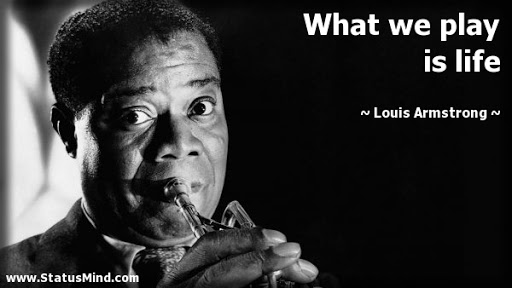
What a Wonderful World
             for Louis Armstrong

 When Satchmo set down the trumpet
 and let his gravelly voice become the music,
 the earth nearly stopped spinning
 in awe of such angelic praise.

 It was a sweltering summer Sunday afternoon
 in my house, Daddy lying on the couch
 with the fat weekend paper, sat up
 and set it aside when the song

 filtered into the living room from the radio,
 filling it with fluttering Monarch butterflies,
 lilac blossoms heavy with scent,
 red hibiscus blooms dripping dew

 onto the rust shag rug, suddenly transformed
 to a carpet of soft green grass my toes
 couldn’t resist & a cool breeze rose up from
 palms trees that shimmied in the corners.

 My mother, who possessed no silly bone,
 showed up in a hula skirt & matched
 the swaying rhythms with her ample hips.
 And soon, my brother joined in,

 shaking a box of salt, & robins bobbed
 heads from their perch on the coffee table,
 & daddy whistled along, while our dog
 rolled cartwheels & ice cream sundaes

 floated down from the sky that once was
 a ceiling, now only cloudless blue.
 And when the song ended as songs do,
 the room became a room again.

 The breeze vanished, along with the trees
 & birds & grass. The staleness of humid
 air asserted itself again and my mother
 complained about the too-bright sun

 & my brother blamed me for something
 I hadn’t done & my father didn’t look up
 from the newspaper, ignoring the fuss.
 Me, I closed my eyes & covered my ears.

 I could still hear Satchmo’s voice rising
 from the middle of my chest, a crooning
 from inside my heart & his raspy, happy
 praise song has lived there ever since.
Lana Hechtman Ayers
The Color of Racismfor Z.S.
Winters,
my nephew drives a snowplow
in a small Colorado town
as white as the snow
he drives into high
compressed banks.
His skin is the color
of hickory bark
with the cinnamon glow
of youth his brief
twenty-three years affords.
He’s shy but quick
to laugh, and when he does
he tilts his chin down,
looks up at you
with his umber pupils
from a doe-eyed angle.
When I think of him
so far away, commencing
his adult life in this
America,
my heart contracts
with ache.
Other seasons, he drives
the county pick-up,
weeds and snips
courthouse shrubbery
into symmetrical shapes.
Justice is not so
manicured.
My nephew’s skin
is the color of dew
in midnight moonlight,
a jewel on this earth
living so far from those
who love him.
My nephew is a member
of the brotherhood
of all men,
as we all are,
with our varying
degrees of melanin,
but the same number
of cytes to make
precious brown pigment.
& Some of us excel
in pigment, my nephew’s
skin rich, beautiful,
mine less so.
Maybe you stood in line
behind my nephew
at Walmart,
you just buying a gallon
of milk, his skin
the color of polite,
said, go on ahead of me.
My nephew loves
video games
and pizza and burritos.
Perhaps you know
a young man like him,
or are the mother of
someone much like him,
or grandfather of, or teacher.
Maybe my nephew has plowed
your roadway,
or someone like him has,
so the streets are safe
for you to pass.
Maybe he mowed the grass
in your neighborhood park
so you could lie out
on sunny spring & summer days
with your picnic and book,
or play frisbee with friends,
or toss a ball to your dog.
My nephew loves dogs.
If he’s been working hard,
his skin glints
as if lacquered with gold
and if you’re lucky enough
to behold it, my nephew’s
contagious smile
will lighten your burdens
for a while,
despite his dark skin.
So when you ask me why
I’m outraged
ask yourself why
to white policemen
&
to white supremacists
&
to whites who say they
don’t see color,
my nephew’s skin
is the color of fear,
the color of hatred,
the color of oppression,
the color of lynching
in broad, bright daylight.